Inverter air conditioning: what it is, how much it saves and whether it's worth it
If you're looking at units to install at home, you'll have seen that almost all current ones carry the word inverter. Inverter air conditioning is the norm today, but what changes versus a non-inverter and does it really save what they say? Here it is, explained clearly, without exaggeration, so you know whether it's worth it for your home in Málaga or the Costa del Sol.
What an inverter AC is
On a non-inverter unit the compressor either runs flat out or it's off: it cools until it reaches the set temperature and shuts off, and when it rises it starts again at full power. An inverter instead regulates the compressor speed and always works at just the power needed to hold the temperature, without starting and stopping all the time. That's why it's more efficient, quieter and reaches the temperature sooner without such a surge.
How much it really saves
Careful: the real saving depends on usage. In a Costa del Sol home, where the unit runs many hours in summer, a properly sized inverter uses noticeably less than a non-inverter of the same size, mainly because it doesn't do constant starts and stops. But the real saving depends on the energy label, the power calculation and how you use it: if you set it to 18°C to cool faster, it saves little, inverter or not. Recommended: 24 to 26°C and good maintenance.
Why it's quieter
Since the compressor doesn't start at full power every time, the inverter ramps up smoothly and you feel it less, both on the indoor and the outdoor unit. In a bedroom the difference is clear. Mitsubishi Electric and Daikin traditionally stand out for silence; Fujitsu and Panasonic too. LG and Samsung have improved a lot in high ranges.
Inverter or non-inverter? There's almost no choice now
Today most mid-to-high-range units we install are inverter; non-inverters have nearly disappeared except in very basic ranges. On the Costa del Sol, with long summers in Alhaurín el Grande, Coín or Cártama and humidity on the coast in Mijas or Fuengirola, a well-sized inverter is what really pays. And if you want cooling throughout with no visible units, ducted air conditioning starts from €800 labour.
Inverter and heat pump
Almost all current inverters carry a heat pump, useful for the mild but humid Costa del Sol winters, where it's more about removing humidity than heating a lot. It usually costs little more than a cool-only one and you'll be glad of it.
When to call a technician
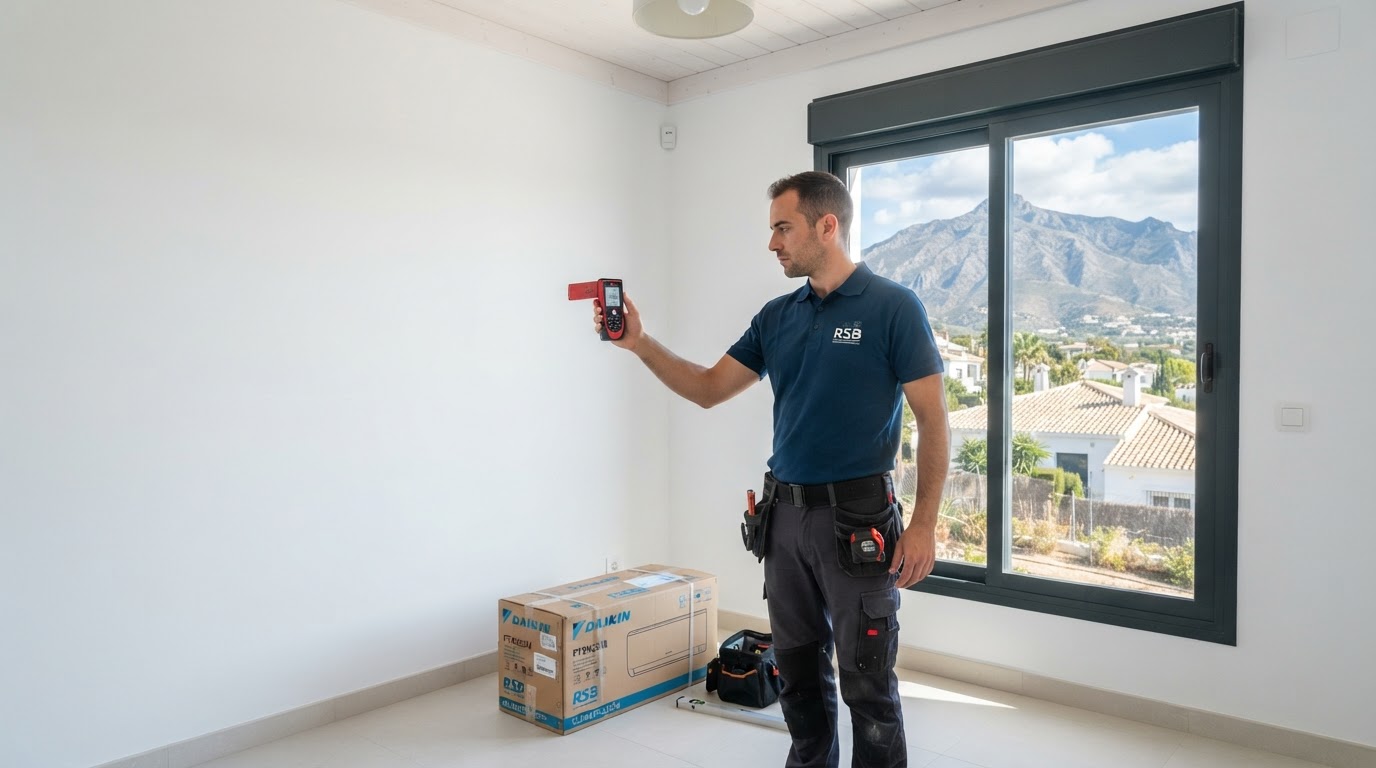
If you're installing a new one or you're not sure which power and which unit fits your home, WhatsApp us a 30-second video of the space and we'll recommend brand, power and whether an inverter is worth it, at no cost. The diagnostic visit is €60 plus VAT, deducted if you accept the quote. At RSB we install Daikin, Mitsubishi Electric, Fujitsu, LG, Samsung, Panasonic and Johnson, and we cover Málaga, Marbella, Fuengirola, Benalmádena, Mijas, Torremolinos, Alhaurín el Grande, Coín and Cártama.
Frequently asked questions
What is an inverter air conditioner?+
It's a unit whose compressor regulates its speed instead of running flat out or off. So it always works at just the power needed, it's more efficient, quieter and reaches the temperature sooner without constant starts and stops.
Does an inverter really save on the bill?+
Yes, if you use it well. In a Costa del Sol home where the unit runs many hours in summer, a properly sized inverter uses noticeably less than a non-inverter of the same size. But the real saving depends on the energy label, the power calculation and the temperature you set.
Is an inverter worth it for a single room?+
Yes, especially if you use it many hours. The inverter is quieter and uses less because it doesn't do constant starts and stops. Today almost all mid-to-high-range units we install are inverter; non-inverters have nearly disappeared.
Need air conditioning?
Call us, WhatsApp us or book a visit.